By Yuvraj Nimankar | Updated 5 October 2026
We are not connected to Saiket Systems or any government body, university or training provider.
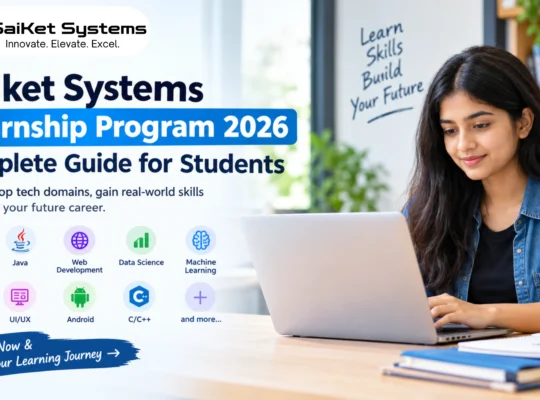
Saiket Systems lists C/C++ Programming among its internship tracks, in a 1-month format. Before you plan around it, check two things. First, whether applications are open, since the track page shows no clear intake window. Second, what your offer mail says about tasks and schedule, because those details usually arrive only after selection.
Saiket Systems C/C++ internship: enrolment status
Unclear as of 5 October 2026. The provider’s internships page lists the C/C++ track but shows no batch date or application deadline for it. Confirm on the official page before you commit.
Quick overview
| Item | Detail |
| Provider | Saiket Systems |
| Program | C/C++ Programming Internship |
| Duration | 1-month format |
| Eligibility | Students, freshers, graduates and other individuals |
| Mode | Remote, per the provider’s general description |
| Certificate | Digital completion certificate, per the provider’s general terms |
| Stipend | Not confirmed; treat as unpaid |
| Start / last date | Not published for this track |
| Enrolment link | https://saiketsystems.in/internships/ |
The provider describes the track as building strong programming fundamentals through practical C and C++ training with real-world coding experience. That describes the format, not the content. No modules, tools or hours are listed, so this guide shows you how to judge the tasks and prepare for them.
Check these before you apply
Some points below come from the provider’s general internship terms, not a page specific to the C/C++ track. Verify each on the official site or by email.
- Is the track open, and what is the deadline?
- Is it unpaid? The provider’s terms treat internships as unpaid, while some third-party reviews mention performance-based stipends. Ask in writing.
- Who owns your work? The terms say work created belongs to Saiket Systems, which affects whether you can publish it.
- Which certificate route applies? The official form gives a digital certificate after review. Email submission gives only a completion confirmation.
- What does “AICTE approved” mean here? See the next section.
How to verify the “AICTE approved” claim
The provider’s pages describe its internships as AICTE approved. Its own terms, however, say certificates are issued under its own brand and that it is not affiliated with any government body or university unless stated in writing. These statements sit uneasily together, so check for yourself:
- Open AICTE’s internship portal and search for the provider and the C/C++ track.
- Check whether the listing names this specific internship, not just the company.
- Ask the provider for the approval reference in an email and keep the reply.
- If you need the internship to count for college credit, ask your college’s training and placement cell whether it will accept it. Do this before you enrol.
A certificate’s value depends on who accepts it, so an approval label alone should not decide for you.
Who is this course for?
It may suit:
- Engineering, BCA and MCA students who know basic syntax but have never finished a complete program.
- Learners who work better with deadlines and a mentor than with self-paced videos.
- Placement-year students who want a project to discuss in interviews.
- Beginners who want a low-risk, one-month trial of systems programming.
Skip it if you need a stipend, an accredited qualification or a guaranteed job. The provider’s terms say completion does not promise employment.
What a strong C/C++ internship should make you practise
Use this as your yardstick when the task list arrives. It is ours, not a claim about what Saiket Systems teaches.
- Pointers and dynamic memory: malloc, free, and spotting leaks, dangling pointers and double frees.
- Data structures built by hand: linked list, stack, queue, dynamic array.
- C++ classes: constructors, destructors, inheritance, virtual functions.
- File handling and input validation: programs that survive bad input.
- Debugging with tools: -Wall -Wextra, AddressSanitizer, Valgrind, GDB.
- Git: small commits with clear messages.
If the tasks are only quizzes and reading, with no program you write yourself, the “practical” label is weak.
Should you learn C or C++ first?
Learn C first if you have a month. C teaches how memory, pointers and functions work without much hiding. C++ builds on that with classes, the standard library and automatic resource management. In a one-month format, spend about the first half on C fundamentals and pointers, then move to C++ classes and the STL. If you rush into C++ without understanding pointers, destructors and smart pointers will feel like magic instead of logic.
Three projects worth building
- Dynamic array (a mini vector)
Teaches realloc, growth strategy and memory safety. A good version doubles capacity when full, checks malloc for NULL, frees everything on exit, and passes Valgrind with zero leaks. - Linked-list contact book with file storage
Teaches pointers, insertion and deletion, and saving data to disk. A good version handles an empty list, duplicate names and a missing file without crashing. - Library or inventory system in C++
Teaches classes, inheritance, virtual functions and encapsulation. A good version has a base class, at least two derived classes, a proper destructor, and no using namespace std; in headers.
For each, write a README with build steps, sample input and output, and known limitations. Publish only if the ownership terms allow.
Two bugs every beginner hits
Bug 1: returning a pointer to a local variable
c
int* bad() {
int x = 10;
return &x; // x is destroyed when the function returns
}
int* good() {
int *p = malloc(sizeof(int));
if (p == NULL) return NULL;
*p = 10;
return p; // caller must free(p)
}
Bug 2: a memory leak and a double free
c
char *name = malloc(20);
strcpy(name, “Asha”);
free(name);
free(name); // double free: undefined behaviour
Fix it by setting the pointer to NULL after freeing, and by owning each allocation in exactly one place:
c
free(name);
name = NULL; // a second free(NULL) is harmless
In C++, avoid manual ownership:
cpp
auto p = std::make_unique<int>(10); // freed automatically
Compile with g++ -Wall -Wextra -fsanitize=address -g main.cpp, or run valgrind –leak-check=full ./app, and the tool will point to the line where memory was misused.
A realistic 4-week plan
- Week 1: Variables, control flow, functions, arrays, strings, structs. Build a student record manager with file storage.
- Week 2: Pointers, pointer arithmetic, heap memory. Build the dynamic array and contact book. Run Valgrind on both.
- Week 3: C++ classes, constructors, destructors, operator overloading. Build the library system.
- Week 4: STL (vector, map), smart pointers, RAII. Polish one project with tests and a clean commit history.
Interview questions this internship should prepare you for
- What is the difference between a pointer and a reference?
- What happens if you call free twice on the same pointer?
- What is a memory leak, and how do you detect one?
- Explain virtual functions and the vtable.
- When do you use unique_ptr versus shared_ptr?
- What is the Rule of Three/Five?
- What is the difference between struct in C and in C++?
- Reverse a linked list. Detect a cycle in a linked list.
If you can answer these with working code, a one-month internship has done its job.
Certificate and recognition
The certificate shows you completed this provider’s tasks and is issued under the provider’s own brand. In an interview, a project you can explain line by line carries more weight than the certificate.
Career and job outcomes
A short internship will not make you job-ready by itself, but it can give you code to discuss. C and C++ lead to embedded and firmware roles, systems programming, game development and performance-critical backend work. Treat the internship as practice and evidence, not as a hiring route.
How to enrol
- Apply through the official internships page.
- Confirm any offer within the stated time. Silence may count as acceptance.
- Read the offer mail for tasks, deadlines and the submission route.
- Complete every task and report progress to your mentor.
- Submit through the official form if you want the certificate.
Keep your offer mail, copies of each submission and your mentor’s feedback.
Common mistakes and problems
- Letting the confirmation window lapse.
- Choosing email submission and expecting a certificate.
- Publishing assigned work without permission.
- Ignoring compiler warnings until the end.
- Skipping Valgrind or AddressSanitizer before submitting.
- Forgetting the null terminator in C strings.
- Using gets() instead of fgets().
- Mixing new[] with delete instead of delete[].
- Falling silent for weeks, since inactivity can end the internship.
- Trusting unofficial channels that offer to “book” a seat.
Is it worth it?
It is worth considering if you want structure and feedback on C/C++ practice and accept that it is short and probably unpaid. The strongest case is a student who knows the basics and needs deadlines to build real programs. The weakest case is someone who needs a verifiable credential or wants to publish all their work openly. Do not drop other commitments until you have seen the actual tasks.
How to succeed in the course
- Write a one-line goal for each task before you start.
- Compile with -Wall -Wextra -g from day one.
- Draw memory diagrams on paper when pointers confuse you.
- Commit after every working feature.
- Ask your mentor what a strong submission looks like.
- Keep personal practice projects, which you can publish freely, separate from assigned work.
FAQs
Is the Saiket Systems C/C++ internship free?
The track page shows no fee, and the provider’s general terms treat internships as unpaid. Confirm in writing before you start.
Does it give a certificate?
Per the provider’s general terms, submitting through the official form gives a digital certificate after review. Email submission gives only a completion confirmation.
How long is it?
The provider describes a 1-month internship format. The exact schedule is set after selection.
Is the AICTE approval real?
The provider’s pages use the label, but its terms say it is unaffiliated with government bodies unless stated in writing. Follow the verification steps above.
Can I publish my internship projects on GitHub?
Not without permission, since the terms say created work belongs to the provider. Build separate practice projects for your portfolio.
What should I learn before starting?
Variables, loops, functions, arrays and basic pointers in C. Install GCC or Clang and practise compiling from the command line.
Will it get me a job?
No. The provider says completion does not guarantee employment.
Can I add it to my resume?
Yes, as an internship you completed. List the skills you practised, not marketing claims.
Who do I contact?
saiketsystems@gmail.com.
Official links
- Official internships page: https://saiketsystems.in/internships/
- Contact: saiketsystems@gmail.com
Last checked 5 October 2026. We update this post when the provider changes dates or rules.