By Yuvraj Nimankar | Updated 10 October 2026
We are not connected to Saiket Systems or any government body, university or training provider.
Students searching for online internship programs will find 20 tracks on the official Saiket Systems page, from Java and Python to Power BI, Cyber Security and IoT. This guide shows how the tracks differ, which ones overlap, how to pick one, and what to ask before you apply. Two checks come first. The page does not say whether the sessions are online or on-site, and it gives no program dates..
Enrolment status
Unclear as of 10 October 2026. The official internships page (last modified 4 October 2026) lists all 20 tracks with “Apply Now” buttons. It does not show a start date, an application deadline or a delivery mode for any of them. Treat “online” in this post’s title as something to confirm in your offer email.
Quick overview
| Item | Detail |
| Provider | Saiket Systems |
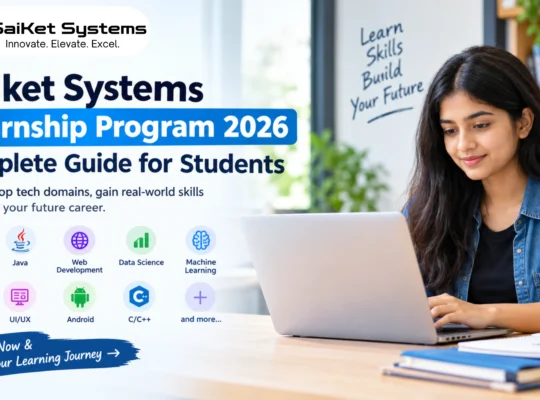
| Tracks | 20, across programming, web and app development, design, data and AI, business reporting, security and IoT |
| Level | Every track is labelled “Beginner to Advanced” |
| Duration | The section heading says 1 Month Internship; your exact period is set in the offer email |
| Mode | Remote |
| Eligibility | Students, freshers, graduates, professionals and individuals, per the provider’s FAQ |
| Certificate | Optional, digital Certificate Provided |
| Program start date | 15 October 2026 |
| Application deadline | 20 October 2026 |
| Enrolment link | https://saiketsystems.in/internships/ |
The page puts “Beginner to Advanced” on every card, so it tells you nothing about which track suits a beginner. The sections below do that.
The 20 tracks at a glance
The page has filter tabs called Development, Data/AI, Data Visualization, Programming and Miscellaneous, but it does not make clear which track sits under which tab. We grouped them by what you actually build. The last two columns are our own reading, not provider information.
| Group | Tracks | What you would typically produce | Sensible starting point |
| Programming foundations | Java Developer, Python Developer, C/C++ Programming | Small programs, then a console or simple application | Logic and loops, no prior tools needed |
| Web and app building | Web Development, Front End Development, Full Stack Development, MERN Stack Development, Software Development, Android Development, Flutter Development | Pages, interfaces, small apps | Basic HTML or one programming language |
| Design | UI/UX Design | Screens, flows, a clickable prototype | Visual interest; no coding needed |
| Data and AI | Data Science, Data Analyst, Machine Learning | Cleaned datasets, analysis notebooks, simple models | Spreadsheets, basic statistics, some Python |
| Business data and reporting | Business Intelligence, Power BI, Business Analytics, Data Visualization (Microsoft Excel) | Dashboards, reports, business recommendations | Comfort with spreadsheets |
| Security and hardware | Cyber Security, IoT | Security checks on practice systems; sensor and device projects | Networking basics; electronics curiosity |
Seven of the 20 tracks are web or app building and six are data or reporting, so most of your competition and most of the advice you will find online sit in those two areas.
How to choose a track
Start from what you already have, not from what sounds impressive.
- You have never written code. Pick a programming foundation track or UI/UX Design. Avoid Full Stack and MERN, which assume you can already build a basic page and handle a database.
- You like spreadsheets and explaining numbers. Data Visualization (Microsoft Excel), Business Analytics or Power BI. These reward clear thinking over coding.
- You know some Python. Data Analyst first, then Data Science or Machine Learning once you can clean data without help.
- You like building things people can click. Web Development or Front End Development. Move to Full Stack only when the front end feels easy.
- You want mobile apps. Android if you want one platform and Java or Kotlin-style tooling; Flutter if you want one codebase for several platforms. Ask the provider which language each track uses.
- You like understanding how systems break. Cyber Security, with a warning: it is the track where practising on systems you do not own is illegal, so insist on a sanctioned practice environment.
- You like hardware. IoT. Ask whether you need to buy components.
If two tracks fit, choose the one whose output you could show a stranger in a single link.
Tracks that overlap
Several titles sound alike. We cannot say how Saiket Systems separates them, since the page describes each in one generic sentence. This table gives our plain-language difference and the question to put to the provider.
| Confusing set | How they usually differ | Ask the provider |
| Data Science, Data Analyst, Machine Learning | Analyst explains what happened; science adds prediction; machine learning focuses on building and testing models | Do the tasks include a model, or only analysis? |
| Business Intelligence, Power BI, Business Analytics | Business intelligence is the practice of reporting; Power BI is one tool for it; analytics leans toward asking business questions | Is Power BI the tool for the BI track as well? |
| Data Visualization (Microsoft Excel) | The same skills as the dashboard tracks, limited to Excel | Does it cover pivot tables and charts only, or also data cleaning? |
| Web Development, Front End Development | Web covers the broad basics; front end focuses on interfaces and responsiveness | What do the first tasks build? |
| Full Stack Development, MERN Stack Development | MERN is one specific full stack toolset (MongoDB, Express, React, Node.js) | Is Full Stack taught in MERN or another stack? |
| Android Development, Flutter Development | Android targets one platform; Flutter targets several with one codebase | Which language and which editor? |
| Software Development, Java, Python, C/C++ | Software Development is the general category; the others fix the language | Is there a language requirement? |
Two tracks can cover almost the same ground under different names, so judge by the task list, not the title.
What the official page does not tell you
For every track, the page omits the syllabus, tools, weekly hours, number of projects, mentor ratio and session schedule. Send one email before you apply, to support@saiket.in, and ask:
- Which tools and languages does this track use?
- How many tasks or projects will there be, and in what format?
- How many hours a week should I expect to spend?
- Are sessions live, recorded or both, and is any part on-site?
- What are the program start date and application deadline?
- Can I apply to two tracks?
- Is the Google Form I am using the right one for my track? (See the next section.)
Save the replies. If a later dispute arises, the answers in writing matter more than the page.
Using the application forms correctly
The page repeats its track cards, and the same track can link to different Google Forms in different places. For example, Java Developer, Data Science and Data Analyst each link to a different form in the two lists we saw on 10 October 2026. Apply from the official page only, and before you submit, check that the form names the track you want or lets you choose it. If it does not, write the track name in any free-text field and mention it in your confirmation email.
The provider’s FAQ says selection can depend on application details, skills, availability and program requirements, so describe your actual skills accurately.
Is one month enough?
The section heading says 1 Month Internship, but your offer email fixes the real period. A month is enough to finish one small project well. It is not enough to master a domain, and it is shorter than most course syllabuses. Here is an illustrative calculation: at 10 hours a week, you get about 40 hours. That covers one front-end page set, one cleaned dataset with a short analysis, or one dashboard with three or four charts, but not a full application with a database and login.
Applying to several tracks at once splits those hours. Choose one, finish a project in it, and consider a second track later.
Eligibility
The provider’s FAQ lists students, freshers, graduates, professionals and interested individuals. It publishes no age limit, ID rule or device specification. If you are not a student or a recent graduate, you can still ask whether you qualify. For any track in the data, development or security groups, plan on a laptop or desktop and a stable connection, because phones are rarely practical for this work.
Certificate, ownership and job outcomes
These rules are the same across all tracks, so we explain them once in our [Saiket Systems Internship Program guide: add link]. Three points matter specifically when you choose a domain:
- Ownership. Under the terms (updated 27 May 2026), everything you create during the internship belongs to Saiket Systems. For design, development and dashboard tracks, that affects your portfolio, so build your showcase pieces on your own time and with public data.
- Recognition. The official page’s title says “AICTE Approved Internships,” while the terms say the program is not affiliated with any government authority or council unless stated in writing. Ask for any approval reference in writing and check it on AICTE’s own website before listing it on a resume.
- Jobs. The terms say completion does not guarantee a job. The provider’s numbers for learners, institution partnerships and hiring partners come with no supporting data, so we cannot verify them.
What to build alongside your track
Whatever you choose, one project of your own on public data protects you from the ownership rule and gives you something to show. One idea per group:
- Programming foundations: a command-line budget tracker that reads and saves a file, with tests.
- Web and app building: a single-page site for a local organisation, tested on a cheap phone.
- Design: a redesign of a government form page, with before-and-after screens and your reasoning.
- Data and AI: a price-change analysis from an open government dataset, finishing with a written conclusion.
- Business data and reporting: a one-page dashboard that answers a single question, such as “which month do sales drop?”
- Security and hardware: a home-network checklist for a family member, or a sensor project that logs room temperature.
Is it worth it?
It is worth considering if you want a deadline, a mentor and a finished project in one domain, and you accept unpaid work. It helps most when you have already picked a direction and need pressure to finish. It helps least if you cannot decide between domains, expect a placement route, or need a credential that employers can verify.
Do not apply to a track just because its title sounds valuable. Pick the track where you already have the prerequisite, and where the first tasks will teach you something you could not get from a tutorial.
Prepare before you apply
A short plan in the weeks before you apply:
- Week 1: Choose one track using the section above, and email the seven questions.
- Week 2: Do the smallest possible starter exercise in that domain, such as a one-page site, a ten-row dataset chart or a short program.
- Week 3: Build the example project from the list above, even if it is rough.
- Week 4: Apply through the official page, with your skills described accurately, and keep a copy of your form answers.
FAQs
Which track is easiest for a complete beginner? None is easy, and the page labels every track “Beginner to Advanced.” In our view, UI/UX Design, Data Visualization (Microsoft Excel) and Python Developer ask for the least prior knowledge, but confirm with the provider.
Can a non-IT student apply? The provider’s eligibility wording is broad enough to include them. Design and spreadsheet-based tracks are the more natural fit.
Are all 20 tracks open right now? The page lists them all but does not say which have open intakes. Ask in your email.
Can I switch tracks after I am selected? The terms do not say. Ask before you accept the offer.
Is the page the only place to apply? Use the buttons on the official page, and ignore messages from anyone offering to “reserve” a seat.
Who do I contact with questions? support@saiket.in, the address in the provider’s current terms.
Official links
- Official internships page:https://saiket.in/internship/
- Internship terms and conditions: https://saiketsystems.in/saiket-systems-internship-terms-and-conditions/
- Contact: support@saiket.in
Last checked 10 October 2026, when we opened the official internships page and the terms. We update this post when the provider changes tracks, dates or rules.